

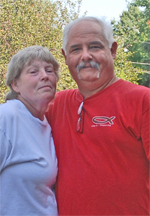
- Ken & Bobbie Marchlenski
Kenneth (Ken) Marchlenski, 59 years old, retired after 35 years with the Dominion (Peoples) Natural Gas Co. Divorced in 2000 after 23 years of marriage and remarried to Bobbie (Roberta) since 2003. Two grown children: Shawn 30 with 2 kids and Jaimie Michelle 25 with 3 children (8, 2.5, 30 months) = 5 grand kids. Former Roman Catholic, saved since 1983. Dispensational type theological background. Spiritual gifts are mainly teaching and evangelism. No time for hobbies with study and family.
Ken has been working on a book to leave as a legacy for his children. What better way to get to know a man? Here is the introduction.
Who is God and What does He want from Me?
by Ken Marchlenski
Introduction
I never realized that knowing something about an author was necessary until I wrote this. Since then, I have learned that insight into the person and their purpose behind any serious work is a great advantage. Therefore, I will candidly go on a bit about myself for my decedent’s sake as well as for the general reader.
At the age of 33, I came to a point in my life where the muscle in my arm and the brain in my head were no longer sufficient for a defense against misfortune. I was forced to try something new; something that I always thought was only for mental patients or old women in rocking chairs: the Bible. To my surprise, I found that it was a book full of wonder and insight (that is, if you start in the right place i.e. the Gospel of John or Romans). The things I read touched me as true and profound. In addition, I realized something else: that perhaps God was knowable after all. However, with the many Christian denominations and their claims of correctness of understanding, I soon learned that keeping notes was essential. As time passed, I found that I had written a fair amount of these notes and began trying to share them with other Christians yet found few interested outside of a seminary. That led me to decide to do my best at making things clear and brief so I could at least leave what I have learned behind as a legacy for my children and grandchildren. I realized that if this were the message from God to humanity, it would be the best system for living life. Furthermore, Christianity is also concerned with where one goes after this life. In fact, it is part of its main theme. Both of these issues have the highest ‘need to know’ value. Therefore not only myself but also my family as well needed to know the Truth, if Truth could be discovered. In addition, because Science seems to be at odds with Religion in general and Christianity in particular, I would also need to investigate its claims. The good news is that over the years I have happily learned that I need not become a scientist to work through most of these problems. First, Christianity has its own scientists who can be sought out and they speak much more candidly giving the whole truth (as known). Along with that, one only need pay attention and think through most of the claims of other disciplines. During my research, I was surprised to learn that science is not always honest and does not always do what it is meant to do: that is, seek out truth, and then report it accurately. I discovered that human prejudices (at times) along with politics help form certain ‘scientific’ conclusions. It would seem that our frail humanity shows through for scientists as well as for we who are religious.
Something else became clear to me: that the present American Body of Christ is in great need of a ‘Cliff Notes’ style of both general and specific instruction. That is, the dissemination of information that would be concise and yet touching more topics and a few of the more difficult subjects as well as the basics. Therefore, I decided to take what I have learned and go beyond simply sharing it with my family by trying to publish it for the general public. I believe that even if this ‘book’ does not reach anyone outside my own family, I will have done a better job of organizing and explaining things than if I had only tried to leave ‘notes’ behind.
From the beginning of my Christian walk, I was determined to learn everything about Christianity and God that I could. I would ask the hard questions and seek out the true answers (when possible). I found it necessary to study at least for 4 to 6 hours daily (and still do), while sometimes studying for nearly 16 hours straight. I knew that what I had learned I would bring home to my loved ones and friends. My still living parents being the first to hear this Good News and being the oldest would probably be the first to die, thus ending their only opportunity to make a decision for Christ. Therefore, from the start, the information, and Gospel that I needed to bring them was to be real food and not the poison of a lie or inaccuracy. That is, as Christianity teaches, if what one believes has a fatal determination on whether one is forgiven or not you had better check make sure you have the Truth. This almost manic study and philosophical thought process for me has gone on for about 25 years now. However, I did ‘slow down’ quite a bit for nearly five of those years because I learned a painful fact: increased knowledge can lead to misunderstanding from both other Christian laymen and even pastors. Therefore, instead of my studies bringing me favor with other Christians, it has often brought me pain and ostracism. Over time, I have learned that this is to be expected.
As I look around this Country, it seems to be a fact that at this time, the American Body of Christ has too many pastors and churches. Men and women who, too often, are not truly called to pastor, and jealously compete with one another for ‘followers’. I believe that too many of us want to be the Indian Chief and not enough of us want to be simply a brave. What the Body of Christ really needs are good laymen who can quietly, and behind the scenes, help support, and augment the work of the man called to pastor, and do it pro-bono if necessary. I also found that due to bad teaching there are many different types of doctrinal errors. With each error, there is a number of Christians who follow these errors, and fill certain denominations. These brothers and sisters who generally stay locked into error by ‘getting busy’ for Christ. This is an error because Christ said He would rather have us all find and speak more of the Truth “(Luke 10:42)”. This book is one of the things that I hope will wake up some of these “Busy-for-Christ” types. These are the ones lost in the processes of service yet at the expense of further learning of fundamental beliefs and doctrines. Truth is hard to find and when found it needs to be cherished and protected from error. How does one protect the Truth? The only way to protect Truth is to test it by taking on all the difficult questions and contentions and seeing if it can be reasonably answered. Only error or a lie is protected by forbidding or limiting questioning. Truth is designed to stand on its own against any reasonable questioning. Therefore, when something or someone will not engage in reasonable dialogue about their claims of having Truth, it is a good sign to the weakness of their position and a lack of true knowledge. Often in-depth truth is relegated to clergy only and this puts the individual at the mercy of another’s views. With something this important, letting another do all of your thinking is always a mistake.
In one large denomination, I found those (pastors and laymen) who were faced with the fact that they have not studied and thought through certain primary doctrines. They relegated in depth study of doctrine and its knowledge of being excessive and unnecessary or even counterproductive to the ‘free leading’ of the Holy Spirit. This of course, goes against the Word of God and I see it as a poor excuse for laziness or the result of bad teaching. Another problem that arises due to the availability of great teaching via the media. Most American Christians have learned quite a few facts about the Bible and Christianity, yet are never able to come to a real understanding of how these facts should fit together. This veneer of knowledge has led many Christians to be intellectually prideful and excessively competitive with each other concerning Biblical knowledge. Everybody is suddenly an expert in Biblical theology. Even many new Christians soon come to believe that they need no personal one on one discipleship. I have led nearly 100 people to Christ individually over these past 25, years and only a handful ever allowed me to instruct them much further. It seems that soon after their profession of Faith they rely solely on the passive learning from the pulpit or that which is available from radio and television. The availability of such great teaching is wonderful but limited and it interferes with the necessary ministry of those who are called to be teachers within the Body. Therefore as one spiritually gifted n this manner, I have turned to writing, because in America personal ‘one on one’ discipleship is practically a lost calling and art.
That is where I find myself today. I hope in writing, to inform at an advanced rate and encourage further thought and study. If this book is not published and not read by the general public, then it will be there for my children whenever they are ready, thus fulfilling my earlier hope.
I believe that every generation must have its own current publications. Books go out of print, language or vernaculars change from generation to generation, and old disputed, ignored, or untaught doctrines go unaddressed or need to be readdressed. There also seems to be a consensus among many Evangelical Christian leaders that today’s Christian lacks the knowledge of our Faith’s basics and often goes intellectually unchallenged. An indication of this would be to look at any Christian Book store. Here you will see fictional novels, self-help and self-realization books all being sold out while the more academic books collect dust or are almost nonexistent. A case in point: I was called to jury duty recently and I happened to notice another juror candidate studying a workbook and leafing through a Bible. I asked her what she was studying and she said that she was as a fairly new Protestant Christian and was studying about the Wilderness Temple (a very complicated subject). She also said that she was working on her PhD in Biology (as I recall). I asked her, if she could defend the ‘Trinity’ or even present it to a Watchtower (Jehovah’s Wittness) member. She thought for a moment and said ‘No’. I also asked her that ‘if she were to die now, where would she go?’ She did not have a good and clear answer (a Christian should know that he or she is Saved and going to Heaven. That is what ‘Faith’ is). She also did not seem to realize the difference between the Roman Catholic and Protestant denominations (which is primarily the type of Gospel that is preached). It also happened that she attended my own large (3500+ member) Evangelical Protestant church. Here is my problem with this scenario: Whoever is leading this young Christian in teaching has failed to equip her with the Basics and instead has mired her in a very complicated study. What is even worse is that her ‘teacher’ is probably unaware of the fact that basic doctrinal instruction is the most necessary of all teaching. It is the first priority. Without it, a new believer can easily be led astray or have their faith hurt. I see this happening all over the Body of Christ. Of course, there are exceptions but again this should be the norm.
In addition, it is a little sad but true, that in today’s Western Civilization, we have formed habits of instant gratification whereby we want it now and with the least amount effort. With all these things in mind, I write this book. Again, my aim is to give the reader the ‘Biggest Bang for their Buck’. That is, to give out as much information as fast and clearly as I can and do it concerning the basics as well as a few important but often overlooked subjects. I consider it common knowledge that all of the subjects that I try to address have had volumes written about them. Therefore, I ask the reader not to relegate what I write as too light or incomplete because this work’s purpose is only meant to ‘jump-start’ one into further study and thought. In addition, I have included a couple of difficult Theological questions (‘the reason for Suffering of the innocent’ and ‘Predestination’) that are seldom addressed. What I say about them I consider Theology yet I realize that a claim can be made that what I say is closer to my own personal philosophy. Any student of either discipline will probably agree that the two must often blend together. Either way, give them some real consideration because I would not present these ‘understandings’ if I did not think that they were worthy of serious consideration. If someone would like to do an exhaustive study on any of these subjects, then I encourage them to do so.
I apologize for any offenses that occur in this book. I am thinking primarily about the Roman Catholics that I may offend as well as the Protestant Armenians who I disagree with on some issues. My aim is to instruct and challenge while trying to remain as neutral as possible. However, due to the very nature of Christianity and the brevity by which I try to write, some things will just be said and the reader will have to try to look beyond my limitations. The old cliché: “You can’t make an omelet unless you break a few eggs” comes to mind.
Because I am hoping to publish this book, my lack of credentials has come into view. There are no ‘letters’ following my name. When this was only meant for my children the only credentials I needed was my love and concern for them. I confess that now, during the latter half of this writing, I ask myself: “Who do you think you are?” I find myself a little embarrassed at this effort. Again, ‘Who am I?’ Perhaps this is something that I must say, so it may have a truly meaningful and lasting purpose. As a Christian, I know that God can use me, the thousands of hours of objective study, and this writing. I also suspect that this may be His providential will. Perhaps only time will answer whether a man such as myself has the right to even propose answers for many of these complex questions. I think to myself of another cliché and ask this question: “Why say anything and thus prove that you are really only a fool?” I leave it to the reader, not of my family to decide the answer to that question. What I do write here is largely based upon the thoughts of those preceding me who were called to think-through such difficult matters. However, I do make a claim that while nothing I say is really ‘new’, some of what I have come to believe is direct common insight from God given to those called to study, and those who then answer that call. In each generation, there are rewards for seeking God. One of these rewards is personally finding certain truths about Him. Truths that are not ‘new’ but over time were diminished to where they we almost ignored. That is, one rediscovers things of God even while just reading and meditating upon God’s Word. Over all, I do all this in accordance with my main daily axiom, which is, “Preach the Gospel and strengthen the saints”.
The best advice I can give anyone is simply this: “Read the Bible”. Start with the Gospel of John and keep going to the end. Nothing I can or will say here can compare to what you will encounter in the Bible. Sounds way too religious I know. Do it anyway.